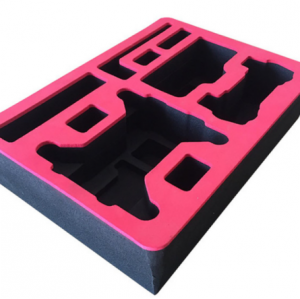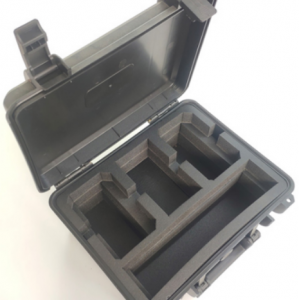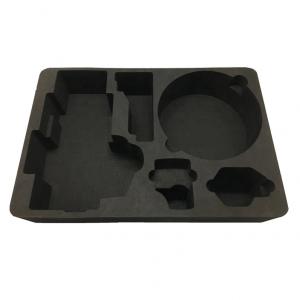

A European electronics manufacturer needed a static-dissipative foam insert light enough to minimize shipping weight yet rigid enough to protect precision nibs and micro-components. Here is how Yufa Polymer delivered a custom ESD XLPE foam insert at the physical limits of the material.
The Challenge: Lightweight ESD Foam Without Compromising Dimensional Control
The customer, a European electronics manufacturer specializing in precision dispensing components, approached Yufa Polymer with a set of requirements that created a genuine engineering tension. Their packaging needed to satisfy four constraints simultaneously:
-
Electrostatic discharge protection — surface resistance between 105 and 109 Ω across the entire insert, meeting ANSI/ESD S541 guidelines for static-dissipative packaging.
-
Minimum possible density — the manufacturer was shipping thousands of units per month to assembly sites across Europe and Asia. Every gram of packaging weight translated directly into freight cost.
-
Tight dimensional tolerances — ±2 mm on total thickness and cavity depths, ±1 mm on individual die-cut profiles. The nibs seated inside these cavities are precision-ground components with strict fit requirements.
-
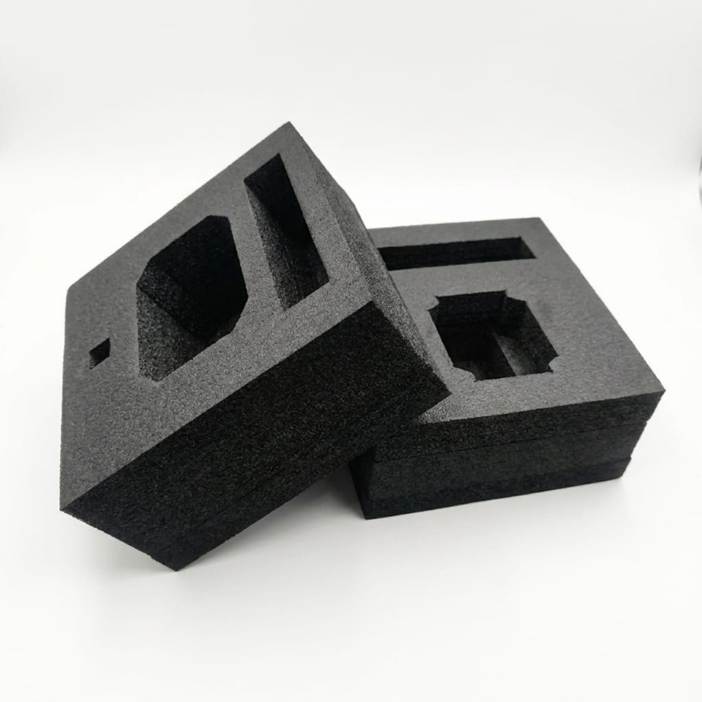
Two distinct cavity variants — the same foam platform had to accommodate two different nib geometries (designated NibRB and NibT), each with its own cavity contour.
Off-the-shelf conductive polyethylene sheets could satisfy the ESD requirement easily, but they are typically produced at densities of 50–70 kg/m³. The customer pushed hard for something closer to 30 kg/m³. The question was how low Yufa Polymer could go while keeping the ESD performance and cut quality stable.
The Solution: Material Engineering Meets Process Control
Why XLPE Foam Was the Right Base Material
Cross-linked polyethylene (XLPE) foam offered several advantages over alternatives such as EVA or PU foam for this particular application:
-
Uniform closed-cell structure — XLPE achieves a very consistent cell size distribution after irradiation or chemical cross-linking, which translates to predictable mechanical behavior even at low densities.
-
Low dust generation — critical for packaging precision electronic components. Unlike open-cell PU foams, XLPE does not shed particles that could contaminate sensitive surfaces.
-
Excellent die-cut edge quality — the cross-linked cell walls maintain their integrity when cut, producing clean vertical edges without tearing. This is essential for achieving ±1 mm tolerances on small cavity profiles.
-
Chemical inertness — XLPE does not off-gas corrosive compounds, making it safe for long-term contact with metal and electronic components.
Determining the Density Floor: 40 kg/m³
Yufa Polymer's engineering team tested ESD XLPE foam samples across a density range of 33 to 50 kg/m³. The conductive carbon filler that gives the foam its static-dissipative properties must be evenly distributed throughout the polymer matrix. As density decreases, the cell walls thin out and the conductive pathways become less continuous.
Key finding: Below 40 kg/m³, surface resistance readings became erratic, with some zones exceeding 109 Ω while adjacent areas measured below 105 Ω. At 40±3 kg/m³, the foam consistently held within the 105–109 Ω window across all tested sample areas.
The customer accepted 40 kg/m³ as the optimal balance point — roughly 20–40% lighter than standard conductive PE foam, while maintaining full ESD compliance.
Die-Cutting and Lamination Process
Each insert measures 136×136×60 mm. At 60 mm total thickness, the foam could not be sourced as a single slab at the required density with reliable ESD uniformity through the full cross-section. Instead, Yufa Polymer engineered a multi-layer laminated construction:
-
Individual XLPE foam layers were die-cut to the required cavity profiles.
-
Layers were bonded using a conductive-compatible adhesive that does not interrupt the ESD pathway across the lamination interface.
-
The bonding process was controlled to keep total thickness within the ±2 mm tolerance, with adhesive layers adding minimal height.
For the two variants (NibRB and NibT), separate die-cutting tooling was produced. Both variants share the same outer envelope dimensions, allowing them to use the same carton packaging and simplify warehouse handling.
Tolerance Control Strategy
Achieving ±1 mm on cavity cuts in a 40 kg/m³ foam requires careful attention to tooling sharpness, cutting speed, and material fixturing. XLPE at this density is soft enough that aggressive cutting can compress the material and spring back, leading to oversize cavities. Yufa Polymer's approach included:
-
High-frequency blade replacement schedule to maintain edge sharpness.
-
Custom fixturing jigs to hold foam sheets flat and prevent lateral shift during cutting.
-
In-process dimensional checks using go/no-go gauges on every production lot.
Results and Benefits
-
20–40% weight reduction compared to standard-density conductive PE foam inserts, reducing per-unit shipping cost across the customer's European and Asian distribution network.
-
Consistent ESD protection — all production lots tested within the 105–109 Ω surface resistance window, verified with per-batch resistance spot checks.
-
Zero fit rejections in the first six months of production — all cavities held within ±1 mm, and total insert thickness within ±2 mm.
-
Single-platform design — the shared 136×136 mm footprint for both NibRB and NibT variants simplified the customer's inventory management and carton standardization.
Technical Specifications
|
Parameter |
Specification |
|
Material |
ESD XLPE foam (cross-linked polyethylene) |
|
Color |
Black |
|
Surface Resistance |
105–109 Ω |
|
Density |
40±3 kg/m³ |
|
Insert Size |
136×136×60 mm |
|
Tolerance — Thickness/Depth |
±2 mm |
|
Tolerance — Cut Profiles |
±1 mm |
|
Variants |
NibRB, NibT (different cavity contours) |
|
Processing |
Die-cutting + lamination/bonding |
|
Packaging |
Carton |
|
Application |
Precision small electronic components / nib packaging |
Why XLPE Foam for Precision ESD Packaging?
Cross-linked polyethylene foam occupies a specific niche in the ESD packaging material landscape. Its cross-linked molecular structure gives it a combination of properties that are difficult to replicate with other foam families:
-
Fine, closed-cell structure — cells are small and uniform, which produces smooth cavity walls after die-cutting. This is particularly important when inserts must cradle components with polished or coated surfaces.
-
Low moisture absorption — XLPE absorbs virtually no water, so its dimensional stability and ESD properties remain constant regardless of humidity conditions during shipping and storage.
-
Wide density range — XLPE can be manufactured from approximately 25 kg/m³ up to 200 kg/m³, giving engineers a broad design window. For ESD-loaded variants, the practical lower bound sits around 40 kg/m³, as demonstrated in this project.
-
Thermal stability — operating range of roughly −40°C to +80°C, suitable for components that may be stored in uncontrolled warehouse environments or transported in extreme conditions.
-
Recyclability — XLPE is a thermoplastic and can be mechanically recycled, supporting customers with sustainability commitments.
For applications requiring higher hardness or load-bearing capacity — such as reusable trays on assembly lines — EVA foam may be a better fit. Yufa Polymer helps customers evaluate both material families during the design phase to ensure the right match for each application. For a detailed comparison, see our guide: ESD XLPE vs. EVA Foam — How to Choose the Right Material.