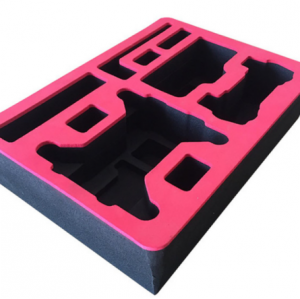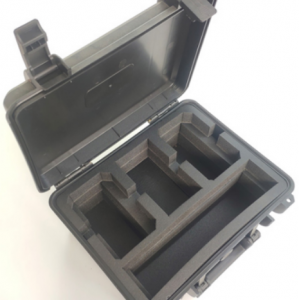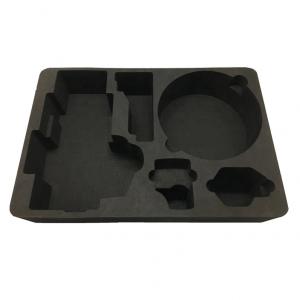

A global PCB assembly provider needed a single anti-static foam tray that could safely carry bare boards, plastic housings, and fully assembled modules on the same production line. Yufa Polymer engineered a 3-layer ESD EVA foam tray with Shore C 60° hardness to solve three problems at once.
The Challenge: Three Product Forms, One Tray
The customer operates high-mix assembly lines for compact electronic modules used in industrial control systems. At any given point on the line, the same product exists in one of three physical configurations:
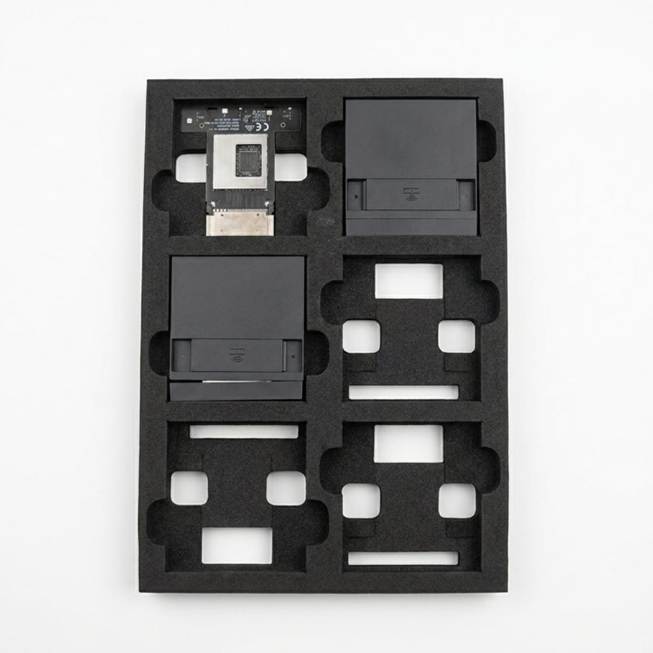
Previously, the line used three different tray designs — one per configuration. This created several operational headaches:
The customer asked Yufa Polymer whether a single ESD foam tray could handle all three configurations without compromising fit, protection, or static dissipation.
Ethylene-vinyl acetate (EVA) foam was selected over XLPE for this application for several specific reasons:
The key insight that made the single-tray concept work was a careful analysis of the three product forms. Yufa Polymer's design engineers identified that:
This meant the cavity needed to be sized to the housing/assembled-module envelope, with the bare PCB naturally fitting within the same pocket. The Shore C 60° hardness ensured that even the lighter bare PCB would not rattle or shift excessively, because the rigid foam walls provide minimal deflection.
Design detail: Each tray holds 6 cavities across a 275×200 mm footprint. An 8 mm corner chamfer on the upper-right corner of each cavity (producing an 11.3 mm hypotenuse) serves as an orientation key, ensuring components are loaded in the correct rotational position every time.
The tray uses a total thickness of 20 mm, built from three distinct layers:
Layer
Thickness
Function
Top layer
12 mm
Contains the die-cut cavities that cradle the components. This is the primary functional layer.
Middle bonding layer
1.5 mm
Thin EVA sheet that bonds the top and bottom layers. Must be aligned precisely with no skewing to maintain cavity floor flatness.
Bottom layer
8 mm
Solid base providing structural rigidity and a flat stacking surface.
The 3-layer approach serves a critical function: the top layer's cavities are cut through the full 12 mm, but the middle bonding layer creates a sealed floor for each cavity. This is more dimensionally stable than trying to cut a blind pocket into a single 20 mm slab, because blind-pocket depth control in foam die-cutting is inherently less precise than through-cutting.
The middle bonding layer required particular attention. A 1.5 mm sheet is thin enough that even slight misalignment during lamination would cause it to extend into the cavity opening or leave gaps at the cavity edges. Yufa Polymer used registration pins during the bonding process to hold all three layers in fixed alignment, ensuring the bonding layer sat straight with zero skew relative to the die-cut pattern above.
Parameter
Specification
Material
ESD EVA foam (ethylene-vinyl acetate)
Color
Black
Hardness
Shore C 60°
Surface Resistance
105–109 Ω
Tray Outer Size
275×200 mm
Total Thickness
20 mm (12 + 1.5 + 8 mm layers)
Cavities per Tray
6
Corner Chamfer
8 mm (11.3 mm hypotenuse), upper-right corner
Processing
Die-cutting + bonding (3-layer lamination)
Packaging
Carton
Application
PCB module assembly line turnover tray
EVA foam is one of the most versatile materials in the ESD packaging toolbox, particularly when the application demands structural performance rather than pure cushioning. Here is what makes it well suited for reusable tray applications:
For applications where lower density, softer cushioning, or ultra-low dust generation are the primary requirements, XLPE foam may be the better choice. Yufa Polymer works with both material families and helps customers select the right one during the design consultation phase. See our comparison guide: ESD XLPE vs. EVA Foam — How to Choose the Right Material.
Why EVA Foam at Shore C 60°
Cavity Design: One Shape, Three Functions
3-Layer Laminated Tray Construction
Bonding Alignment Control